Time is Finite: The Sooner You Realize, The Better
It’s a harsh truth many fail to realize early on: our time is finite. I was once scattered, saying yes to everything, ending up everywhere yet nowhere. This changed when I grasped the limitations of my time.
Realizing that agreeing to everything wasn’t the pathway to success, I learned the importance of discerning what to embrace and what to decline. Herein lies the role of setting priorities. Many of us neglect this, treating every task with equal importance, leading to suboptimal achievements.
If everything holds the same significance, you’ll attempt to accomplish it all within your limited timeframe. Especially in tech, where numerous skills demand mastery, an undiscriminating approach fosters competition between learning tasks.
The saying “movement doesn’t necessarily mean progress” rings true. Being everywhere doesn’t equate to proficiency. Stretching oneself too thin yields minimal progress.
This reflection serves as a reminder to myself and others to prioritize effectively, ensuring meaningful progress rather than mere motion.
So, how can we better prioritize in our quest for skills, given the multitude of essential learnings? I utilize a framework that I’ve termed the “SkillPrio Framework” to address this challenge:
SkillPrio Framework – by Ehoneah Obed
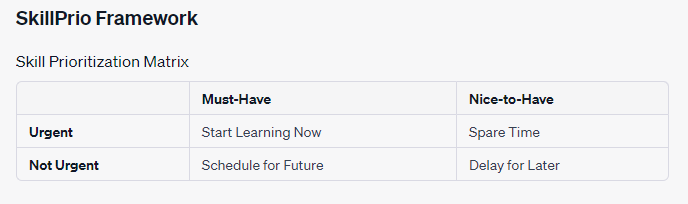
In this framework:
Must-Have (Urgent): These are skills that are crucial for your current goals and have an immediate need. You should prioritize these and start learning them right away.
Must-Have (Not Urgent): These are essential skills, but they are not needed immediately. You can schedule them for future learning and incorporate them into your long-term plans.
Nice-to-Have (Urgent): While these skills would be beneficial, they are not critical for your current goals. You can consider working on them during your spare time, but they shouldn’t interfere with your must-have urgent skills.
Nice-to-Have (Not Urgent): These are skills that are not immediately necessary and can be put on hold until you have more time or until they become more relevant to your goals.
Note that priorities can shift with changing circumstances and goals, necessitating regular reviews and adjustments.
I’m in the process of refining and publicly releasing this framework to aid in skill prioritization.
Stay tuned for the framework! In the meantime, start categorizing your pursuits using this quadrant to guide your approach.
Until tomorrow!

Dr. Ehoneah Obed (Pharmacist, Software Engineer, Health Informatician, Founder)
My work focuses on identity engineering, which is the deliberate process of designing and updating who you are, personally and professionally.
Most people experience identity as something fixed or accidental. It is shaped by parents, early success or failure, education, and society’s definition of what a “good life” looks like. They adapt to it rather than questioning it. What most people do not realize is that identity is not just something you discover. It is something you can actively engineer.
Personal identity engineering is about gaining control over how your beliefs, values, and self-concept are formed and reinforced.
Professional identity engineering is about translating that internal identity into skills, work, leverage, and visible contribution in the world.
When people feel stuck, it is rarely because they lack motivation or talent. It is because they are trying to change outcomes while leaving the underlying identity system untouched. Careers stall. Confidence collapses. Direction feels unclear. The system keeps producing the same results.
I learned this by rebuilding myself multiple times.
I trained as a pharmacist for six years. While working in hospitals, I began learning to code alongside my job. That led to building real software, selling products, transitioning into software engineering, completing a master’s degree in health informatics at the University of Toronto, and now building startups and systems full time. Each transition followed the same pattern. My identity did not change because I thought differently. It changed because I took specific actions that produced new evidence, and that evidence forced a new story about who I was capable of being.
That is the core mechanism behind identity engineering.
Identity updates when you intentionally generate evidence that contradicts your old self-image, then compound that evidence until the old identity can no longer run the system.
This blog is where I document that process. I write about how to design identity experiments that are small, controlled, and reversible. How to build proof-of-work that changes both how you see yourself and how the world responds to you. How to move forward without waiting for clarity, confidence, or permission.
This is not motivation and it is not coaching. It is systems thinking applied to human change.
I also write The Ledger, a weekly record of systems and experiments for building a life you own.
And I built the Identity Audit, a diagnostic tool that helps you understand your current identity state before you attempt to change it.
I am not presenting a finished theory. I am engineering this in real time, using my own life as the test environment. If you want more agency over who you are becoming, both personally and professionally, you are in the right place.